BlueDiver Quantrix
One strip measures up to 25 autoantibodies in U/ml, from 10 µl of serum, in one hour. Every strip carries its own calibration curve and its own controls.
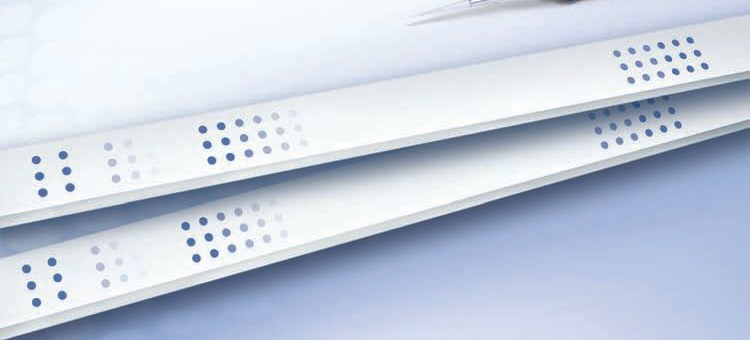
A patient with a positive ANA can have one of many diseases. Testing antigen by antigen means several kits and several runs. ANA25 covers six disease groups on one strip, in the same hour.
One strip
Lupus, Sjögren's, systemic sclerosis, mixed connective tissue disease, myositis and autoimmune liver disease share symptoms and often overlap. One strip tests for all six groups, from the same sample, in the same run.
Groups show the disease each antibody is usually linked with. The diagnosis stays with the clinician.
A classic dot or line blot is read against one cut-off: positive or negative. Quantrix reads a number.
| Qualitative immunodot | BlueDiver Quantrix | |
|---|---|---|
| Result | Positive or negative, by eye or semi-quantified | A value in U/ml for every antigen |
| Reference | One cut-off control on the strip | A six-point calibration curve on every strip, including a blank |
| Each antigen | One dot | Three dots, with the spread between them measured |
| Antibodies on one strip | Up to 12 | Up to 25 |
| Validation | A reaction control and a cut-off control | Reaction, conjugate and substrate controls, checked automatically |
| Report | Positive or negative for each antigen | Value, grade from equivocal to high positive, and standard deviation |
Left column: D-tek's own BlueDiver Dot range. Both run on the same BlueDiver Instrument.
Calibration
Six standards, 0, 6, 12, 25, 50 and 100 U/ml, are coated in triplicate on each strip. They are developed with the patient's sample, in the same reagents, at the same moment.
So there is no separate calibration run and no stored curve from another day. The scanner reads the six standards, draws the curve, and reads each antigen against it.
The curve and the points are from D-tek's example report: ANA25Q-24, strip 4.
The same strip, as the Dr DOT software reports it: three readings and their mean for each antigen, graded on D-tek's scale.
Reading it
SSA/Ro 60kD is high positive and SSA/Ro 52kD medium positive; nucleosome and dsDNA are low positive. Everything else on the strip, from Scl-70 to the liver antigens, was measured and is negative.
Scale in U/ml, as printed on the Dr DOT report. Example data from D-tek, not a patient of ours.
Choose by the question the clinician is asking. All three are quantitative, 24 tests a kit, and run on the BlueDiver Instrument.
The widest screen: connective tissue diseases, myositis and autoimmune liver disease on one strip.
The connective tissue panel, with RNA Polymerase III for systemic sclerosis and DFS-70 to help read a positive ANA.
Autoimmune liver disease only: primary biliary cholangitis and autoimmune hepatitis types 1 and 2.
Liver10 IgG · LI10Q-24
When the clinician asks whether a liver disease is autoimmune, Liver10 measures ten antibodies in one run.
M2 is tested four ways, as the native complex and as three recombinant subunits, beside gp210 and sp100. The same strip carries the markers of autoimmune hepatitis type 1 and type 2.
ANA19 IgG · ANA19Q-24
For laboratories that follow rheumatology patients: nineteen antibodies, quantified.
It adds two antigens that ANA25 does not carry. RNA Polymerase III belongs to the systemic sclerosis group. DFS-70 is a frequent cause of a positive ANA screen, and knowing it is there helps the clinician read the rest.
For the person who runs the bench and signs the reports.
Run 1 to 24 strips, and mix panels in the same run. Three samples today are reported today.
The same instrument, scanner and software run the qualitative BlueDiver Dot strips and the quantitative Quantrix strips.
Each strip carries its calibration and its controls, and each antigen its three readings and their standard deviation.
The barcode reader checks that strip and cartridge match and that neither has expired.
Dr DOT stores every result with the scanned image, and exports to CSV, LIS and PDF.
Reagents arrive in sealed, ready-to-use cartridges. There are no pumps or tubes to service.
For the rheumatologist or hepatologist who ordered the test.
The report names which antibodies on the panel are present, so the clinician sees which disease group to look at.
A value in U/ml and a grade give a baseline to compare the next sample with.
ANA25 shows connective tissue, myositis and liver antibodies on the same report.
Every antigen on the strip is reported with its value, including the ones that are negative.
On ANA19, for the ANA-positive patient and for systemic sclerosis.
Liver10 reports the PBC antibodies and those of autoimmune hepatitis types 1 and 2 together.
Point at any row: what is coated where, and what each control proves.
No dilution, no reagent pipetting, no wash steps to time. Add 10 µl of serum, load, and start.
Strips, sealed reagent cartridges and 10 µl of serum for each patient.
The instrument checks the barcodes and runs the test by itself.
After one hour, place the strips on the BlueScan.
Dr DOT calculates every value and prints or exports the report.
Key characteristics
| Kit | 24 nitrocellulose strips with their ready-to-use reagent cartridges |
|---|---|
| Method | Enzyme immunoassay, antigens coated as microdots |
| Sample | 10 µl, no predilution |
| Autoantibodies | Up to 25 on one strip |
| Test duration | 1 hour |
| Processing | BlueDiver Instrument |
| Reading | BlueScan and Dr DOT software, version 4 or later |
| Results | Quantitative, in U/ml |
| Controls | Positive, negative, conjugate and substrate controls, and the calibration curve |
Each kit is 24 tests. Tell us how many tests you expect and we quote for the year.
Runs on
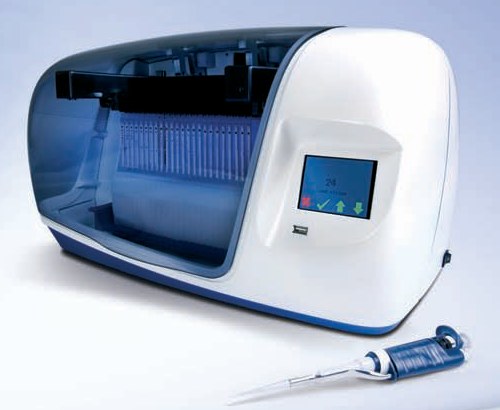
Quantrix strips are processed on the BlueDiver Instrument: 24 strips in one hour, with no pumps, tubes or liquid handling.
Official distributor
Al Murtaja Medical Equipment (MME) is the distributor of D-tek s.a., Belgium, in Iraq, Syria and Jordan.
We supply D-tek's instruments and reagents, install them, train the laboratory's team and provide technical support, from our office in Amman.
